


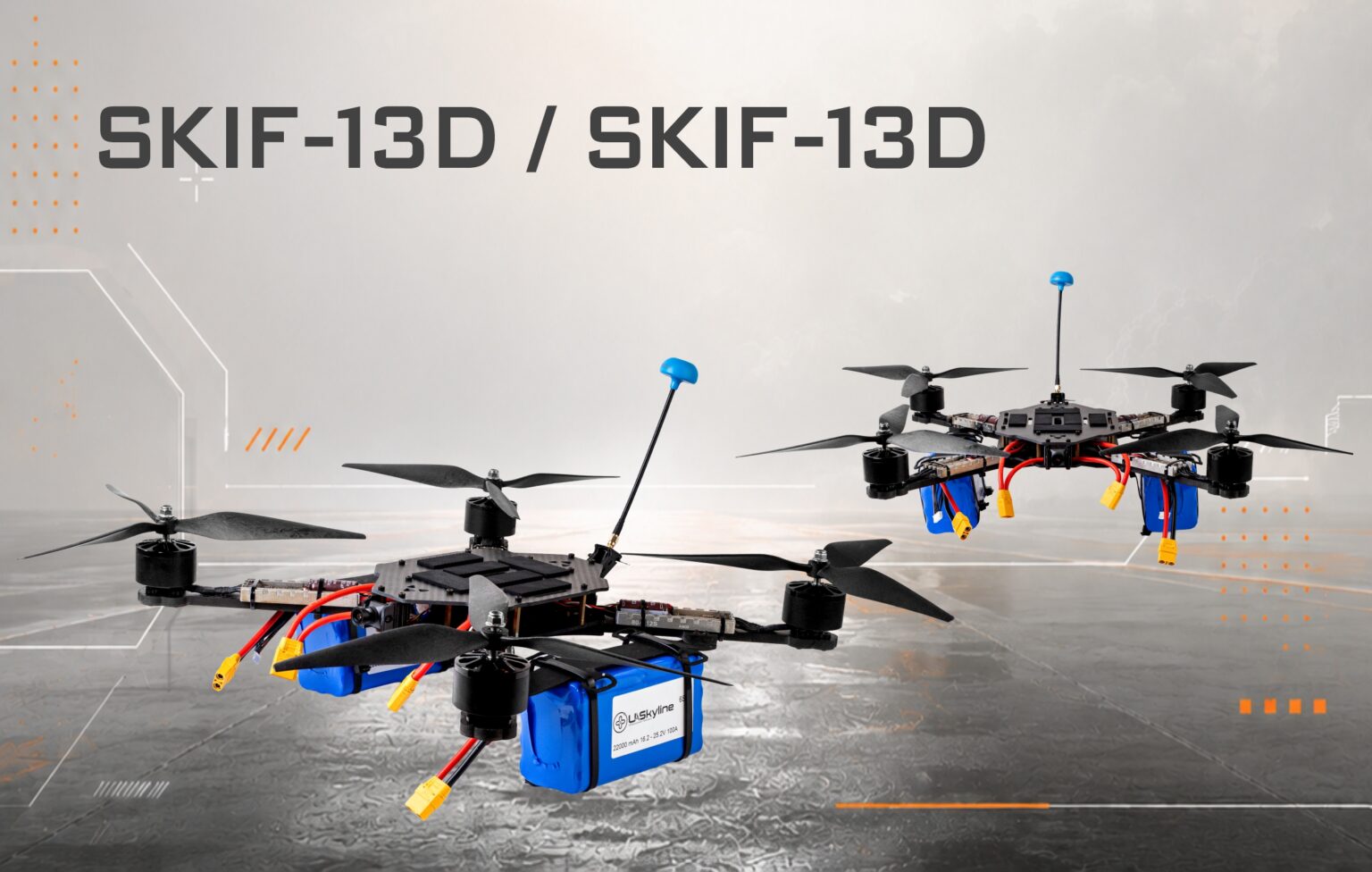
When are the capabilities of a more compact FPV drone no longer sufficient? What does switching to a 13-inch platform actually provide – greater payload capacity, a different propulsion configuration, or an increased operating radius? And how do you choose between SKIF-13D and SKIF-13TN if the basic flight characteristics of these models are practically identical?
13″ platforms should be evaluated comprehensively. The larger format allows operation with greater system weight and payload, but at the same time increases requirements for power supply, propulsion system, and overall structural balance. In the UASkyline FPV Kamikaze category, this class is represented by the SKIF-13D and SKIF-13TN models, with a maximum payload of up to 5 kg and a tactical operating radius of up to 40 km.
When a 13″ FPV Platform Is Justified
The main structural advantage of the 13-inch format is the ability to build a system with greater weight capacity and thrust reserves. This is particularly noticeable when compared with more compact models from the same product line.
For the SKIF-13D, the manufacturer specifies a maximum payload of up to 5 kg and a recommended payload of up to 4.5 kg. The SKIF-13TN has similar specifications. Both models are built on a 13″ platform and use the same basic architecture.
The 13-inch class should be considered when the technical requirements place increased demands on:
- Permissible payload weight;
- Thrust reserve;
- Platform stability at a higher total weight;
- Power system capacity;
- Operating radius;
- Integration of additional equipment.
At the same time, a larger frame alone does not determine the efficiency of the system. The weight of the entire configuration, batteries, propulsion system, camera, and operating conditions must be taken into account.
SKIF-13D and SKIF-13TN: One Platform, Different Observation Systems
The two models are extremely similar in terms of their main flight characteristics.
| Specification | SKIF-13D | SKIF-13TN |
| Frame size | 13″ | 13″ |
| Tactical operating radius | up to 40 km | up to 40 km |
| Maximum speed | up to 120 km/h | up to 120 km/h |
| Cruising speed | 70 km/h | 70 km/h |
| Maximum payload | up to 5 kg | up to 5 kg |
| Recommended payload | up to 4.5 kg | up to 4.5 kg |
| Camera | Daytime | Thermal imaging |
| Operating temperature range | -10…+55 °C | -10…+55 °C |
| Permissible wind speed | up to 20 m/s | up to 20 m/s |
The key difference is the optics. The SKIF-13D is equipped with a daytime camera. This configuration operates with video images in the visible spectrum and is suitable for tasks where lighting conditions allow the use of a standard visual channel.
The SKIF-13TN uses a thermal imaging camera. The model specifications indicate the possibility of configuring a sensor with a resolution of 256×192, 384×288, 640×512, or 960×768 pixels according to customer specifications.
Therefore, the choice between D and TN is primarily determined by the requirements for the observation system rather than differences in speed or permissible payload.
Which Specifications Determine the Capabilities of SKIF-13
For both models, the basic configuration includes two 6S4P Li-ion battery packs of 24,000 mAh each. This power capacity meets the requirements of the larger 13-inch system and its weight. The actual operating radius, speed, and payload performance depend on the specific configuration, installed batteries, equipment, and operating conditions – as the manufacturer separately notes in the specifications.
That is why the specifications should be evaluated together:
- Payload. A maximum value of up to 5 kg does not mean that every system should be operated at its limit. For both models, the recommended value is up to 4.5 kg.
- Speed. SKIF-13D and SKIF-13TN reach speeds of up to 120 km/h, with a specified cruising speed of 70 km/h.
- Radius. Both configurations have a specified tactical operating radius of up to 40 km.
- Operating conditions. The operating temperature range is from -10 to +55 °C; the permissible wind speed is up to 20 m/s.
In other words, a heavy FPV platform is not built around a single maximum specification. What matters is the balance between weight, power supply, payload, and the capabilities of all installed components.
Conclusion
SKIF-13D and SKIF-13TN are 13-inch FPV platforms designed for configurations requiring greater payload capacity and operating radius. Both models have a tactical operating radius of up to 40 km, a maximum speed of up to 120 km/h, and support a payload of up to 5 kg.
The main difference between them lies in the observation system: SKIF-13D uses a daytime camera, while SKIF-13TN uses a thermal imaging camera with the option to select a sensor according to specifications.
Therefore, choosing a heavy FPV platform should begin with three parameters: the required payload, observation conditions, and operating radius requirements. After that, the configuration can be adapted to a specific technical task.