

.svg.webp)
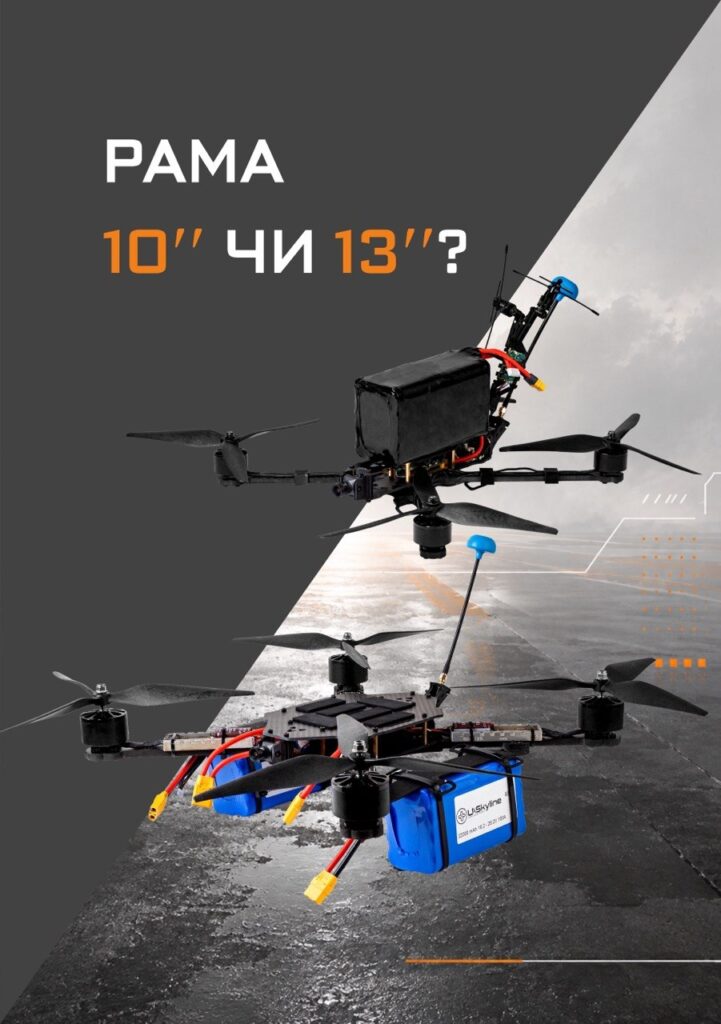
Which FPV drone should you choose – 10″ or 13″? Will a larger frame provide a noticeable increase in thrust and payload capacity? How will maneuverability, power consumption, and powertrain requirements change?
It is impossible to answer these questions based solely on propeller diameter. The size of an FPV platform determines the available space for the powertrain, the type of motors, power supply parameters, structural weight, and allowable payload. However, the actual characteristics are formed only when all components operate as a single system.
The UASkyline FPV kamikaze category includes models of different formats, including the SKIF-10D and SKIF-13D. Their characteristics clearly demonstrate why 10″ and 13″ platforms should be compared not by a single parameter, but by their entire configuration.
What Changes When Moving from a 10″ to a 13″ Frame
Increasing the format allows the use of larger-diameter propellers and a corresponding powertrain. This creates the potential for higher thrust, but at the same time changes the weight, inertia, and power requirements.
In practice, platform size affects several key parameters:
- Powertrain thrust reserve;
- Allowable payload weight;
- Weight and dimensions of the FPV drone itself;
- Acceleration dynamics and changes in direction;
- Selection of motors, ESCs, and battery;
- Power consumption;
- Ease of transportation and system preparation.
A larger propeller diameter can improve thrust generation efficiency, but only if the motors, voltage, battery, and total weight of the structure are properly matched. This is why simply increasing the frame size does not guarantee better performance.
10″ FPV Drone: When a Balance of Characteristics Matters
A 10-inch platform makes it possible to combine sufficient thrust reserve with relatively compact dimensions. Compared with larger FPV systems, it has lower weight and inertia, which affects the drone’s response during acceleration and maneuvering.
In the UASkyline product line, this format is represented, among others, by the SKIF-10D. It has a stated range of up to 35 km and a speed of up to 140 km/h.
At the same time, the characteristics of a specific platform depend not only on the frame size. The motor configuration, power supply system, equipment weight, and parameters defined by the technical specifications remain important.
The 10″ format is worth considering when it is necessary to combine a high-performance powertrain with smaller system dimensions while maintaining sufficient FPV drone dynamics.
13″ FPV Drone: What a Larger Format Provides
A 13-inch frame makes it possible to build a powertrain around larger propellers and corresponding motors. Such a configuration creates greater thrust potential and provides more options for working with system weight and payload.
An example is the SKIF-13D, with a range of up to 25 km and a maximum speed of up to 140 km/h. Comparing the SKIF-10D and SKIF-13D clearly demonstrates an important pattern: increasing the size of an FPV drone does not automatically increase its range or speed. Both models have the same stated maximum speed, while their range figures differ.
A 13″ platform primarily changes the possibilities for building the powertrain and working with thrust and weight rather than automatically improving all drone characteristics.
10″ or 13″: Which Parameters to Consider When Choosing an FPV Platform
The two formats should be compared based on the technical specifications rather than frame size alone.
| Parameter | 10″ | 13″ |
| System dimensions | Smaller | Larger |
| Weight and inertia | Lower | Higher |
| Powertrain potential | Balanced | Higher thrust potential |
| Power requirements | Depend on configuration | Usually higher |
| Maneuverability | Higher with a comparable configuration | More dependent on system weight |
| Transportation | Easier | Requires more space |
| Payload | Determined by configuration | More options for heavier configurations |
The compatibility of all components must also be taken into account. The UASkyline components section includes frames, motors, flight controllers, electronic speed controllers, and other elements used to build unmanned systems.
Choosing the right frame does not begin with the question “10 or 13 inches?” but with the requirements for range, weight, thrust, operating time, and operating conditions.
Conclusion
10″ and 13″ FPV drones have different design logic. The smaller format makes it possible to reduce the dimensions and inertia of the system, while the larger platform provides more possibilities for building a more powerful powertrain and working with payload.
At the same time, frame size alone does not determine the characteristics of an FPV drone. Range, speed, thrust, and flight behavior depend on the motors, propellers, power supply system, weight, and configuration of the entire platform.
Therefore, before choosing between 10″ and 13″, it is worth first defining the system requirements and only then selecting the frame and compatible components. UASkyline develops and adapts FPV solutions according to specific technical specifications and operating conditions.